
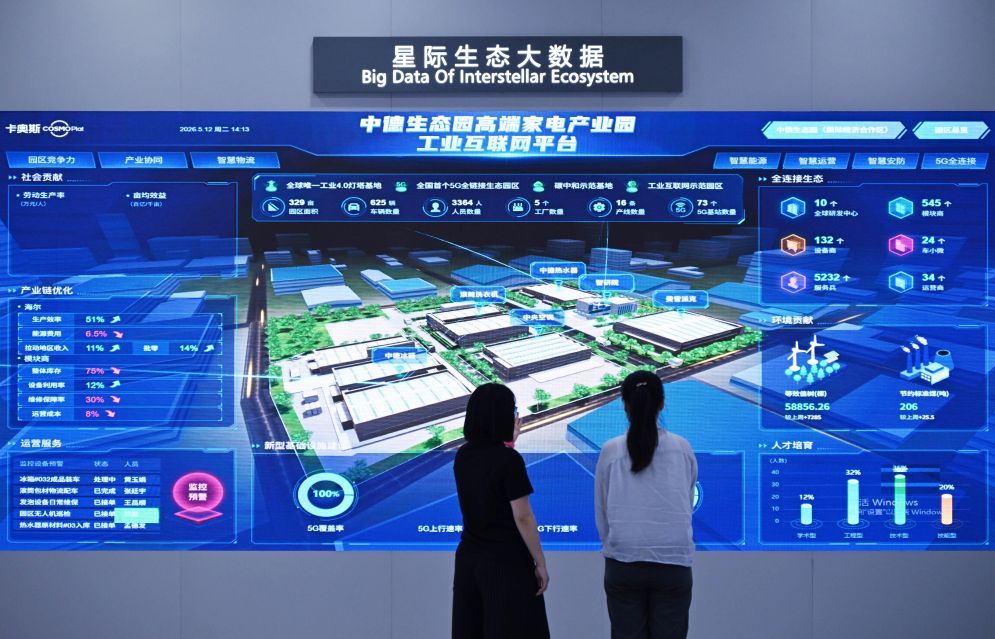
The Ministry of Industry and Information Technology, together with six other government departments, has jointly issued the Action Plan for Promoting Synergistic Development of Large, Medium, and Small Enterprises in the Platform Economy (2026–2028). The plan charts a clear course for accelerating the transformation and upgrading of China's platform economy and fostering integrated growth among enterprises of all sizes.
As a new economic form, the platform economy relies on internet platforms as its core carriers, bringing together diverse players including large platform enterprises, a vast number of small and medium-sized merchants, and service providers. In Anshan, Liaoning Province, for example, the smart supply chain service platform built by Delin Land Port Supply Chain Service Co., Ltd. integrates online trading, smart logistics, warehousing and distribution into one-stop services, and has attracted more than 40,000 upstream and downstream enterprises and clients in the steel industry chain. “Leveraging big data and the Internet of Things, we are transforming from a traditional logistics company into a modern supply chain service provider,” said Wang Feng, chairman of the company.
In recent years, the platform economy has played an increasingly prominent role in empowering the real economy—connecting supply and demand, driving industrial transformation, and boosting employment. Platform enterprises have moved beyond their traditional roles as information intermediaries and matchmakers, evolving into new types of digital infrastructure that integrate data, technology, and application scenarios, and have become a critical pillar supporting the transformation and growth of small and medium-sized businesses.
At the same time, challenges remain, including insufficient industrial collaboration, unbalanced development among enterprises, and impeded flows of production factors, all of which urgently need to be addressed. An official from the Information and Communications Administration of the Ministry of Industry and Information Technology noted that China’s platform economy is at a critical juncture of transformation and upgrading, and it is essential to adapt to the new circumstances and requirements of the "15th Five-Year Plan" period, as well as broader technological and industrial changes, in order to accelerate the building of an innovative, integrated, healthy, and efficient development ecosystem.
The term "synergy" features prominently throughout the action plan. “Targeting the structural imbalances in the development of large, medium, and small enterprises within the platform economy, the plan adopts a systematic approach to build a multi-dimensional collaborative framework, enabling the orderly flow and efficient allocation of production factors within the ecosystem,” said Yu Xiaohui, President of the China Academy of Information and Communications Technology. The plan prioritizes "innovation synergy," calling on platform enterprises to step up their artificial intelligence efforts, including general-purpose large models, industry-specific large models, and intelligent agents, while also supporting the development of incubators for small and medium-sized enterprises and accelerating the emergence of "one-person AI companies." Yu noted that some large firms possess technology but lack application scenarios, while some smaller ones have innovative ideas but lack resources—leading to resource misallocation along the innovation chain. The plan's provisions on technological innovation, industrial innovation, and innovation services will help resolve such coordination problems.
The action plan also aims to reshape the relationship between platform companies and small and medium-sized enterprises, fostering a fairer, more transparent, well-regulated, and highly collaborative ecosystem. It launches initiatives to enhance the quality and brand-building of smaller firms, support their global expansion alongside larger partners, and strengthen compliance management—all with the goal of building a coordinated ecosystem covering compliance, industrial development, services, and overseas expansion, and promoting two-way empowerment between platforms and the SMEs within their ecosystems. In addition, the plan addresses the urgent need to break down data silos and smooth the circulation of production factors. It calls for opening up and sharing of technology, data, and computing power with smaller enterprises, and for accelerating the formulation of platform openness lists, so that resources become visible, accessible, and mobile, thereby continuously removing barriers to factor flows.
Looking ahead, as new models such as "AI plus platform economy" continue to evolve, the platform economy will see a greater diversity of participants and more complex organizational forms and operational mechanisms. Industry insiders believe that all stakeholders should take the action plan as a starting point to build an open, shared, diversified, collaborative, and innovation-driven platform economy development system. In this system, large enterprises can gain ecological vitality through the openness of their capabilities, while small and medium-sized enterprises can unlock their innovation potential through the circulation of production factors. This will create a virtuous cycle of value co-creation and mutual benefit, bringing the development of China’s platform economy to a new and higher level.