
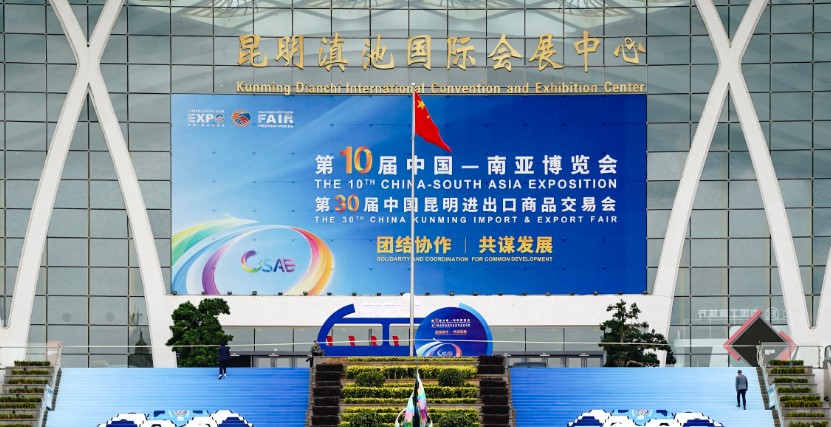
[AEX NEWS] KUNMING – As a journalist who frequently covers Southeast and South Asia, I am no stranger to regional trade fairs. Yet walking into the 10th China-South Asia Expo (CSA Expo) in Kunming, I was struck by an overwhelming sense of the future – this felt less like a traditional bazaar and more like a portal to tomorrow’s technology.
Held from June 11 to 16 at the Kunming Dianchi International Convention and Exhibition Center, this year’s expo carried the theme “Unity and Cooperation for Common Development” and featured 13 themed pavilions. The most telling change was the elevation of the Service Trade Hall to a standalone core pavilion – a clear signal that China is pivoting from a goods‑trade focus to a dual‑engine model of goods and services trade. And the force driving that shift, as I witnessed firsthand, is nothing less than ubiquitous, cutting‑edge innovation.
Service Trade Hall: The Future Has Arrived
Stepping into Hall 1 – the Service Trade Hall – with its purple carpet and cyberpunk lighting felt like entering a sci‑fi set. The hall spotlighted three strategic areas: artificial intelligence, digital trade, and cross‑border computing power corridors – precisely the frontier battlegrounds of global tech competition.
What drew the biggest crowd was a fully autonomous UAV inspection system named the “Sacred Lotus.” Resembling a mythical lotus lamp from Chinese folklore, this drone system requires no human piloting. Once a mission is dispatched via the control platform, it autonomously swaps batteries, takes off, collects data, returns to its nest, and generates inspection reports – all without intervention. The poetic fusion of cultural symbolism with industrial hardware struck me as uniquely Chinese in its aesthetic.
Nearby, an AI‑powered tea‑brewing robot called “Tea Egg” performed with equal flair. Drawing on a database of over 300 global tea varieties and AI algorithms, it precisely replicates the brewing process of Pu'er tea, delivering a perfect cup in just over ten minutes. By turning the art of steeping into reproducible data, the robot frees up human tea masters to focus on storytelling and sensory experience – a powerful illustration of AI as an enabler, not a replacement.
The hall also bristled with smart inspection terminals, AI‑driven cross‑border data services, multilingual real‑time translation devices, and various service robots. According to on‑site staff, these technologies already cover diverse scenarios including customs inspection, public services, cross‑border communication, low‑altitude operations, and risk management. From tea ceremonies to drone patrols, from translation to inspection – Chinese AI is seeping into real‑world production and daily life at an astonishing pace.
Tesla also made an appearance with its humanoid robot, Tesla Bot, at the entrance of Hall 1. Seeing such cutting‑edge robotics in a southwestern Chinese city was itself a powerful signal: China’s openness to and embrace of advanced technologies goes far beyond what many overseas observers imagine.
Manufacturing Hall: From “Made” to “Intelligently Made”
If the Service Trade Hall showcased soft power, Hall 3 – the Manufacturing Hall – demonstrated hard muscle. Under the theme “Intelligent Manufacturing Links the Future, Cooperation Drives Development,” the hall gathered nearly 40 industry leaders, showcasing more than 200 cutting‑edge innovations. Among them were four Fortune Global 500 companies, 23 national‑level “Little Giant” specialized‑and‑sophisticated firms, 22 high‑tech enterprises, and 11 listed companies.
New energy vehicles, low‑altitude economy systems, rail transit, and drone engines – once the exclusive domains of advanced economies – were everywhere. CRRC displayed its heavyweight national‑champion technologies; Leadway Auto unveiled the world’s first L‑series electric passenger car equipped with CTP (cell‑to‑pack) technology; and Kunming Yunnei Power, with over 60 years in the power equipment sector, showcased its three core lines – vehicle power, generator sets, and smart terminals – tailored precisely for the diverse needs of overseas markets in South and Southeast Asia.
As a journalist who has long observed South Asian markets, I know how vital infrastructure upgrading and industrialisation are for countries from Pakistan to Bangladesh, from Sri Lanka to Nepal. What the Manufacturing Hall offers is precisely cost‑effective yet technologically robust solutions – exactly what these nations are looking for.
Green Energy Hall: China’s Clean‑Tech Blueprint
In Hall 2 – the Green Energy Hall – I encountered yet another dimension of technological strength. With the theme “Building an Energy Corridor, Sharing New Green Momentum,” the 10,000‑square‑metre pavilion brought together 18 state‑owned giants including Huadian, Datang, China Southern Power Grid, PetroChina, and Sinopec.
Using holographic crystal‑film screens, VR experiences, and digital sand tables, visitors could intuitively grasp innovations in smart grids, digital inspection, drone line‑patrol, and intelligent O&M (operations and maintenance). International media colleagues noted that the exhibits highlighted hydrogen business models, photovoltaic power generation, and large‑scale energy infrastructure. Organisers revealed that nearly 25 key projects are expected to be signed during the expo.
At a time when climate action is a global consensus, China’s accumulated know‑how and industrial scale in green energy are delivering affordable clean‑tech options for South Asia and beyond.
Technology Is Reshaping the Expo’s DNA
According to official figures, this year’s CSA Expo attracted participation from 68 countries, regions, and international organisations, covering all South Asian, Southeast Asian, and RCEP members. More than 1,500 professional buyers gathered in Kunming, with overseas buyers accounting for over 60%. A total of 112 Fortune Global 500, China 500, and industry‑leading companies signed up – a telling number that reflects where global capital and industry are placing their bets.
From a goods‑trade focus to a dual‑engine of goods and services; from “Made in China” to “Intelligently Made in China” – the 10th CSA Expo showed me not just an upgraded trade fair, but a concentrated display of national technological clout. The tea‑brewing robot, the lotus‑shaped drone, the sleek electric vehicles, and the full‑chain green‑energy solutions – all these seemingly scattered exhibits form a coherent picture: a complete innovation pipeline from basic research to technology transfer, from industrial application to international cooperation.
As a foreign correspondent who has covered numerous global expos, I can clearly see that China is no longer just the “world’s factory” – it is becoming a vital birthplace of global technological innovation. And the CSA Expo, right here in Kunming, is a tangible, visible microcosm of that new reality.